
Prediction Markets Are Digital OxyContin
How We're Repeating the Purdue Pharma Playbook in Real Time.

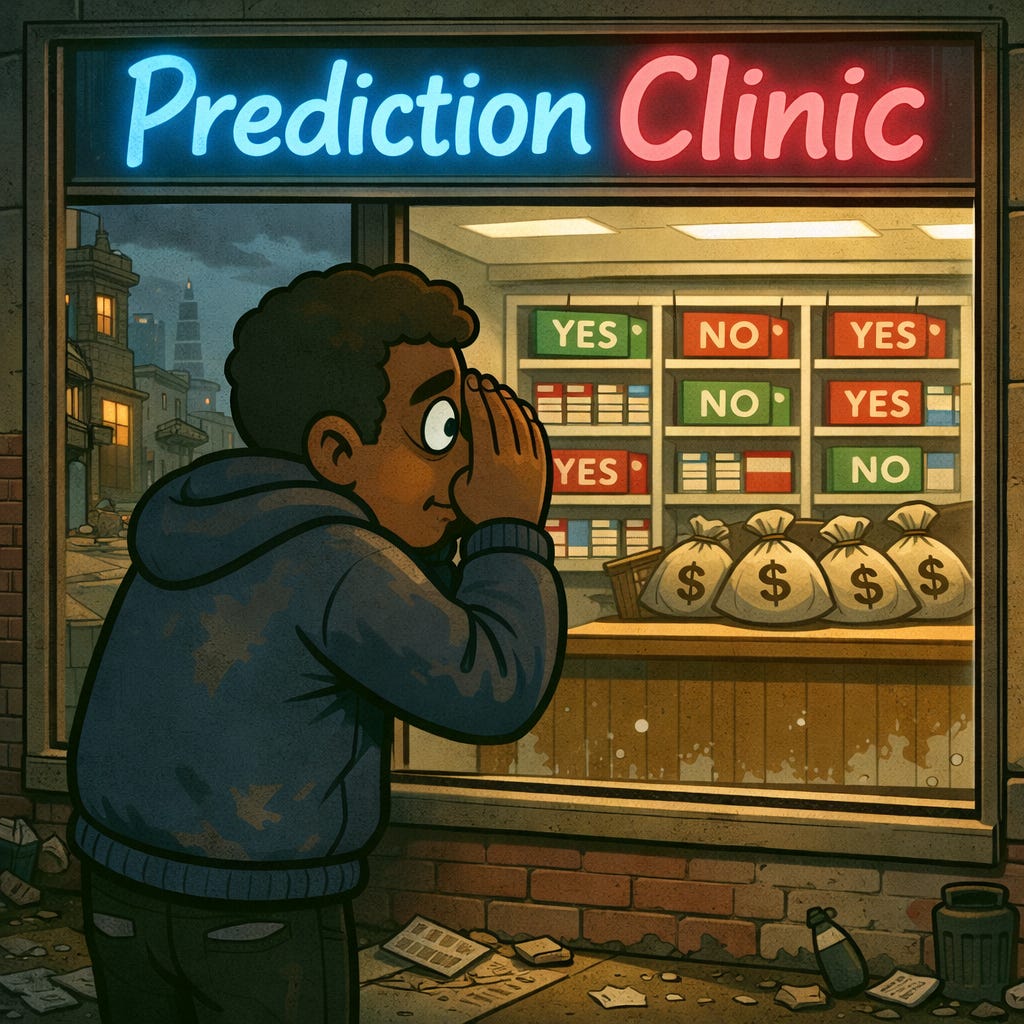
We love a good downfall story. Bad Blood. Going Infinite. Super Pumped. There’s something magnetic about watching high-flying companies collapse under the weight of their own hubris. We devour these narratives with a particular hunger—part schadenfreude, part validation. When life feels unfair, when success seems arbitrary, these stories whisper a comforting lie: they were cheating, and that’s why they won.
But there’s one book in this genre that haunts me differently than the others: Empire of Pain, Patrick Radden Keefe’s devastating chronicle of the Sackler family and Purdue Pharma. Unlike Theranos or FTX, which were frauds from inception, the opioid crisis emerged from something that actually worked. OxyContin was effective. It helped people. And that’s precisely what made it so dangerous.
I can’t shake the feeling that we’re watching the exact same story unfold with prediction markets.
The Playbook
The Purdue Pharma story follows a seductive arc. Start with a genuine innovation solving a real problem: terminal cancer patients suffering unbearable pain, facing a choice between agony at home or morphine drips in hospice wards. Develop a controlled-release opioid technology that allows dignity in dying. Get FDA approval for this narrow, beneficial use case. So far, so good.
But here’s where things get interesting. That market—dying cancer patients—turns out to be too small to fuel the ambitions of a pharmaceutical company with billions in potential revenue. The technology works. The patents are solid. The only limitation is the size of the addressable market.
So you expand. You take a tool designed for extreme circumstances and position it for everyday chronic pain. Back pain. Arthritis. Sports injuries. The FDA pushes back, noting the obvious addiction risks. Opioids have a well-documented history of dependence and abuse. This seems like a catastrophically bad idea.
And then comes the critical move: you don’t accept the regulatory constraint. You deploy capital, lobbying power, and captured academics to manipulate the system. You fund studies with predetermined conclusions. You wine and dine regulators. You create patient advocacy groups that are really marketing arms. You convince doctors that pain is under-treated and addiction is rare. You turn medical journals into promotional vehicles.
The result? Millions dead. Tens of millions of lives destroyed. Communities hollowed out. A social crisis that will take generations to repair.
The tragic irony is that OxyContin did have legitimate medical value. It wasn’t a fraud like Theranos. The medicine worked. But something having value doesn’t mean it doesn’t have catastrophic harms. The ledger can show a positive and still be damning.
The Prediction Market Parallel
If you’re paying attention to the trajectory of prediction markets, the pattern should be uncomfortably familiar.
Start with a genuinely useful application: weather derivatives for farmers. If there’s unseasonable frost and your crop fails, you get a payout. It’s insurance, reimagined through market mechanisms. Agricultural commodity hedging has existed for centuries. This is a refinement, not a revolution, but it’s beneficial. It helps people manage genuine risk.
But—and here’s where we’ve seen this movie before—that market isn’t big enough. The total addressable market for agricultural weather derivatives is measured in millions, maybe low billions. Not the kind of numbers that attract venture capital or justify billion-dollar valuations for prediction market platforms.
So you expand. Suddenly it’s not just weather insurance for farmers. It’s betting on elections. On geopolitical events. On celebrity deaths. On literally anything that can be formulated as a binary question. The platforms justify this expansion with the same rhetorical move Purdue made: look at the beneficial use cases! Prediction markets aggregate information! They help with forecasting! They’re more accurate than polls!
All of which is true, in the same way that OxyContin effectively manages pain.
Then comes regulatory pushback. The CFTC and SEC look at prediction markets and see what they obviously are: gambling platforms. Unregulated casinos where people can bet on anything, with all the attendant social harms that gambling creates. Addiction. Financial ruin. The psychological toll of turning every aspect of life into a zero-sum game.
And now we’re watching the critical move play out in real time. Rather than accepting regulatory constraints, prediction market advocates are deploying the exact same playbook Purdue used. Lobbying. Political contributions. Captured academics arguing for the “social value” of unfettered prediction markets. The regulatory capture is happening before our eyes, with many of the same people who expressed outrage over the opioid crisis cheering it on.
The Uncomfortable Truth
The most insidious thing about both OxyContin and prediction markets is that they do have value. That’s what makes the playbook work. If these were pure frauds, they’d be easier to dismiss. But there’s a kernel of legitimate benefit that gets weaponized to justify unlimited expansion.
Yes, terminal cancer patients benefited from controlled-release opioids. That doesn’t justify prescribing them to every teenager with wisdom tooth pain. Yes, farmers benefit from weather derivatives. That doesn’t justify turning every aspect of human existence into a betting market.
The question isn’t whether something has any value. The question is whether the net impact on society is positive or catastrophically negative. And we have extensive evidence—from sports betting, from casino gambling, from literally every other form of legalized wagering—about what happens when you make it frictionless to bet on outcomes.
We know the psychology of gambling addiction. We know the social costs. We know which communities bear the brunt of those costs. We know that the house always wins, and we know who the house is in prediction markets: the platforms and the sophisticated traders who exploit information asymmetries.
The Tell
Here’s what gives the game away: look at who’s funding the expansion of prediction markets. Look at who’s lobbying regulators. Look at whose political campaigns are receiving contributions from prediction market advocates. It’s not farmers worried about frost. It’s not social scientists seeking better forecasting tools. It’s crypto billionaires and effective altruists who’ve decided that gambling markets are the next frontier for deregulation.
The same people who brought you FTX (literally the same people) are bringing you unregulated prediction markets. That should tell you everything you need to know about the actual motivations at play.
And the brazenness is remarkable. We’re less than five years past a crisis that killed over 100,000 Americans annually at its peak, a crisis caused by taking something with marginal legitimate use and expanding it to maximize profit regardless of social cost. The hand-wringing, the congressional hearings, the promises that we’d learned our lesson—all of it is memory-holed the moment the next opportunity for regulatory arbitrage appears.
A Pattern We Should Recognize
I read business disaster stories not for schadenfreude but for pattern recognition. Empire of Pain isn’t just about one family’s greed. It’s a blueprint for how beneficial technology gets weaponized, how regulatory capture happens, how we collectively allow catastrophic harm in pursuit of profit.
Prediction markets are following that blueprint step by step. We’re early enough in the process that we could choose differently. We could decide that some markets shouldn’t exist, that not everything should be financialized, that the marginal social benefit of slightly better election forecasting doesn’t justify creating another vector for gambling.
But here is my prediction. If the pattern holds—and based on the lobbying dollars being deployed, it seems likely it will—we’ll look back in a decade at the mental health crisis, the financial ruin, the social fragmentation caused by gamifying every aspect of existence, and we’ll write another Empire of Pain. We’ll express outrage. Those profiting now will apologize profusely for promoting prediction markets. We’ll wonder how we let it happen.
And someone, somewhere, will already be running the same playbook on the next thing.
Thanks for being a Perishable Knowledge subscriber.
If you are getting value from my blogs, I’d appreciate it if you share this post with someone who will enjoy it. (If you’re reading this email because someone sent it to you, please consider subscribing.)