
No One Wants Software
Apps Are Just Crappy APIs

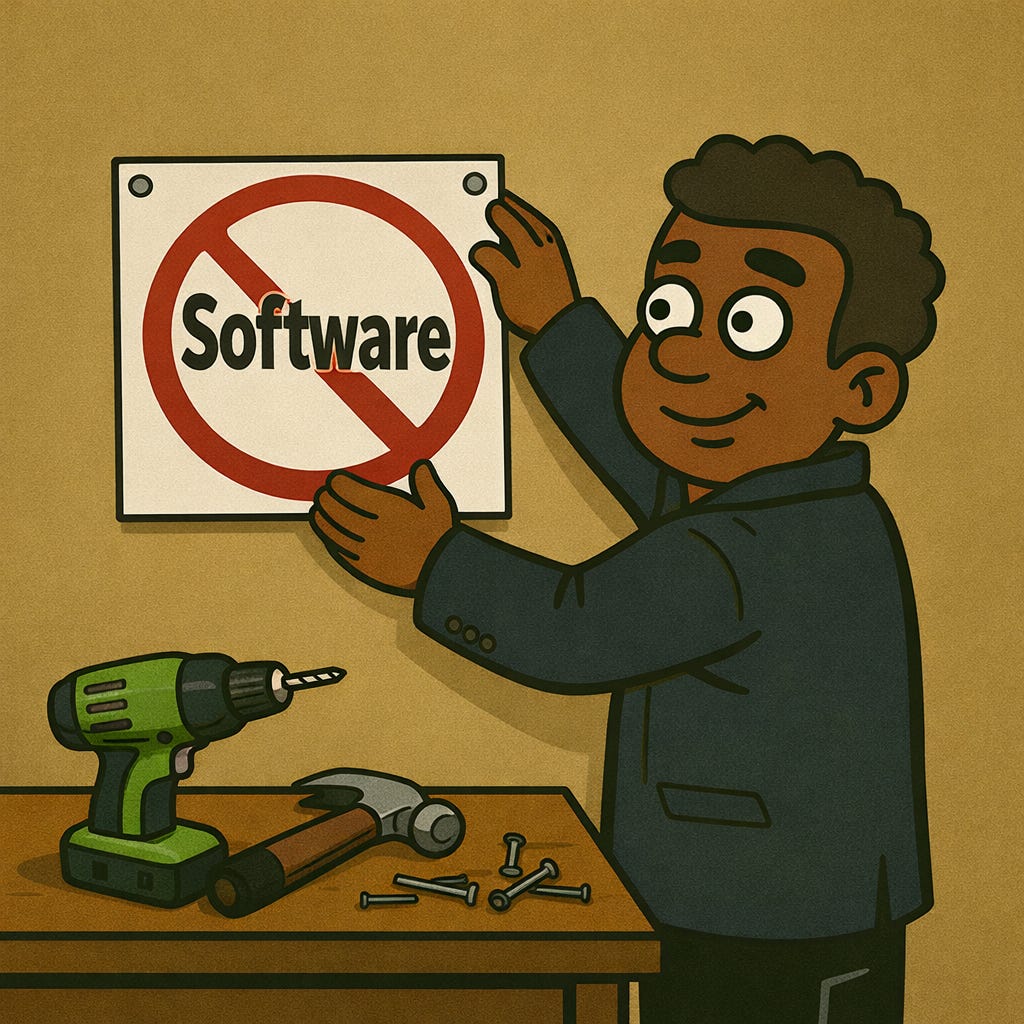
I was sitting with a founder last week who was walking me through a demo of their product — a website automation tool for e-commerce merchants. Beautiful interface. Thoughtful design. Clearly a lot of care had gone into the experience. And about halfway through the demo, she said something that stuck with me: “Honestly, most of our users don’t even log in anymore. Their agents just trigger everything through the API.”
She said it like it was a minor product insight. But I think it’s one of the most important observations in software right now, and it connects directly to a debate I’ve been following closely — this question of whether SaaS is dying.
I wrote an earlier piece on the “perplexification” of software, where I argued that AI was shifting software from process optimization to objective fulfillment. That piece fired off a heated debate on LinkedIn and X, but I wonder if that piece didn’t go far enough. Because the more I sit with it, the more I think the real insight isn’t about AI replacing steps in a workflow. It’s something more fundamental than that.
Nobody ever wanted software in the first place. They wanted a task done.
Hanging A Picture
There’s a classic saying in product development: people don’t want a quarter-inch drill, they want a quarter-inch hole. It’s a good line. But I wonder if people don’t want the hole either — they want the picture hanging on the wall. And if you really zoom out, they want the feeling they get when they walk into a room and see it hanging there. The drill, the hole, the nail, the wire — all of that is just a means to an end. Necessary at the time, but never actually the point.
Software is the same way. We built all of it — the development kits, the frameworks, the design systems, the buttons and drop-down and onboarding flows and settings pages — because of the limitations of our technology and the limitations of our own biology. Our fingers needed something to click. Our eyes needed something to read. Our brains needed information organized in ways we could process sequentially, one screen at a time. And so we constructed this enormous apparatus of interfaces and interactions and user experiences, all of which served a real purpose, but none of which anyone actually wanted for its own sake. It was a necessary evil. Magnificent, well-intentioned, occasionally beautiful. But redundant nonetheless, and in retrospect, a remarkable amount of it was a human tax.
The Human Tax
Think about what most applications actually are when you strip away the sentimentality. It’s a graphical layer sitting on top of a set of functions. The buttons, the navigation, the onboarding flows, the settings pages — all of it exists because a human needs to see, understand, and manually trigger those functions. The application is the tax we pay for having a human in the loop.
And it goes deeper than UX. Think about all the dark patterns we’ve normalized. Those cookie consent banners that are intentionally engineered to be confusing, designed to trick you into letting companies scrape your data and follow you across the internet. The manipulative opt-in flows. The “are you sure you want to unsubscribe?” guilt trips. All of that exists because there’s a human on the other end who can be psychologically manipulated. Remove the human — or at least reduce their role significantly — and the entire manipulation layer evaporates. An agent doesn’t get tricked by a dark pattern. It doesn’t feel guilt. It just calls the API.
Corporate Bloat
Nowhere is this more obvious than inside the corporation. Look at the software stack of any mid-to-large company. Almost all of it exists to manage the overhead of having humans coordinate with each other. ERP systems. HRIS platforms. Recruiting tools. Onboarding tools. Calendar management. Meeting coordination. Email. Slack. All of it is tied to the bloat associated with the underlying human. It’s layers upon layers of process infrastructure that exists not because the work requires it, but because humans require it to do the work.
When you look at enterprise software through the lens of an agent rather than a human, the entire value proposition shifts. What it means to be a good product, a performant product, changes completely. Nobody needs a beautiful UI if no human is looking at it. Nobody needs an intuitive onboarding flow if the “user” is a piece of software that reads documentation in milliseconds. Nobody needs the application. The interface becomes irrelevant. The API becomes everything.
Slow, Then All At Once
I think MCP was an attempt to get us closer to this agentic world — a standard way for agents to interact with the functions underneath our applications. But it was too structured, too rigid in the form factor it expected agents to work within. CLI is getting us closer. When you watch someone work with Claude Code or Cursor, you’re already seeing what it looks like when the application layer starts to become optional rather than essential. For agents, an most applications behave like slow, crappy APIs.
So is SaaS dying? I think the honest answer is that the question itself is a bit of a distraction. In YCombinator, we lived by the mantra “make something people want,” and maybe the more useful question is: whether or not people ever wanted software?
If your product is fundamentally a pretty face on an API, and the pretty face is increasingly irrelevant, then you have to think carefully about what else you’re bringing to the table. Data, integrations, network effects, regulatory compliance — those things still matter. The human bloat around them increasingly doesn’t.
I think the question isn’t whether SaaS is alive or dead — it’s whether your software product is designed to be the objective or just part of the process. If you’re delivering the outcome directly, you’re fine. If you’re a series of screens that helps a human navigate their way toward an outcome, you’re human bloat that’s about to get skipped. Not because you failed, but because you succeeded at something nobody actually wanted in the first place. You helped people do the thing. Now something else can just do it.
Thanks for being a Perishable Knowledge subscriber.
If you are getting value from my blogs, I’d appreciate it if you share this post with someone who will enjoy it. (If you’re reading this email because someone sent it to you, please consider subscribing.)
Good stuff Collin! I saw this come in while building something with AI! Keep the thought provoking content coming!