
I Can Now Do Infinite Things. That's the Problem.
What Mario Kart Is Teaching Me About Working With AI


For most of the history of technology and business, the central question was could.
Could we build this? Could we afford it? Could we find the people? Could we get it to market before the window closed? Constraints were everywhere — technical, financial, organizational — and they shaped everything. Strategy was largely a function of capability. You mapped your resources, identified what was actually achievable, and worked backward from there.
But even then, even in a world defined by constraint, the real question was never could. It was should.
Should was always harder. Could at least had an answer — yes or no, feasible or not. Should required you to hold up every possible action against some standard, some outcome, some version of success that you actually cared about. It required judgment. And judgment is harder to outsource than execution.
Most people didn’t do the judgment work. They let the constraints do it for them. If you couldn’t afford to hire more engineers, you didn’t have to decide which features to build — the budget decided. If the market was closed, you didn’t have to decide which opportunity to pursue — the market decided. Constraint masquerading as strategy. Limitation doing the work of leadership.
AI has changed this in one very specific and profound way: it has eliminated could as a meaningful constraint.
Mario Kart And Mushrooms
The list of things you could do is now effectively infinite.
I could build an app every day. I could research every company in every sector. I could reach out to every LP I’ve ever met every week, deeply research every deal that crosses my desk, code every tool I’ve ever wished I had, reply to every email instantly. I could do all of that — and still have capacity left over. The bottleneck is no longer time spent on execution. AI compresses execution to near-zero.
This is genuinely remarkable. And genuinely dangerous.
Because when could disappears as a constraint, the only thing left is should. And most people — most organizations — have never actually built the muscle to answer that question on its own. They’ve always had constraint to lean on. Now they don’t.
The result is a kind of infinite productivity that doesn’t feel like freedom. It feels like vertigo. You’re surrounded by an endless list of things you’re capable of doing, and nothing to stop you from doing all of them badly.
And here’s the part that doesn’t get said enough: AI doesn’t just accelerate your ability to get things done. It also accelerates your ability to get wildly off course.
I remember Mario Kart as a kid — specifically the ghost levels, where you can pick up a magic mushroom that gives you a massive speed boost. If you’re pointed in the right direction when you use it, it’s extraordinary. You gain ground instantly, you pull ahead, everything compounds in your favor. But if you’re not pointed in the right direction — if your angle is even slightly wrong — the mushroom doesn’t help you. It launches you off the edge of the track and into the abyss, where you have to wait for a little cloud with a fishing pole to fish you back out and set you back down where you started, having lost everything you gained.
AI is the magic mushroom. Applied with clear direction, it’s one of the most powerful accelerants in the history of productive work. Applied without that clarity — before you’ve done the hard thinking about what you should actually be doing — it just shoots you off the edge faster and further than you could have gone on your own. The same force that makes it extraordinary when you’re aligned makes it dangerous when you’re not.
The question has always been what should you be doing. AI just made it both more urgent and higher stakes.
The Three D’s
I’ve used a simple rubric for years to manage this — long before AI made it urgent. I call it the Three D’s: Delete, Delegate, Do, in that order.
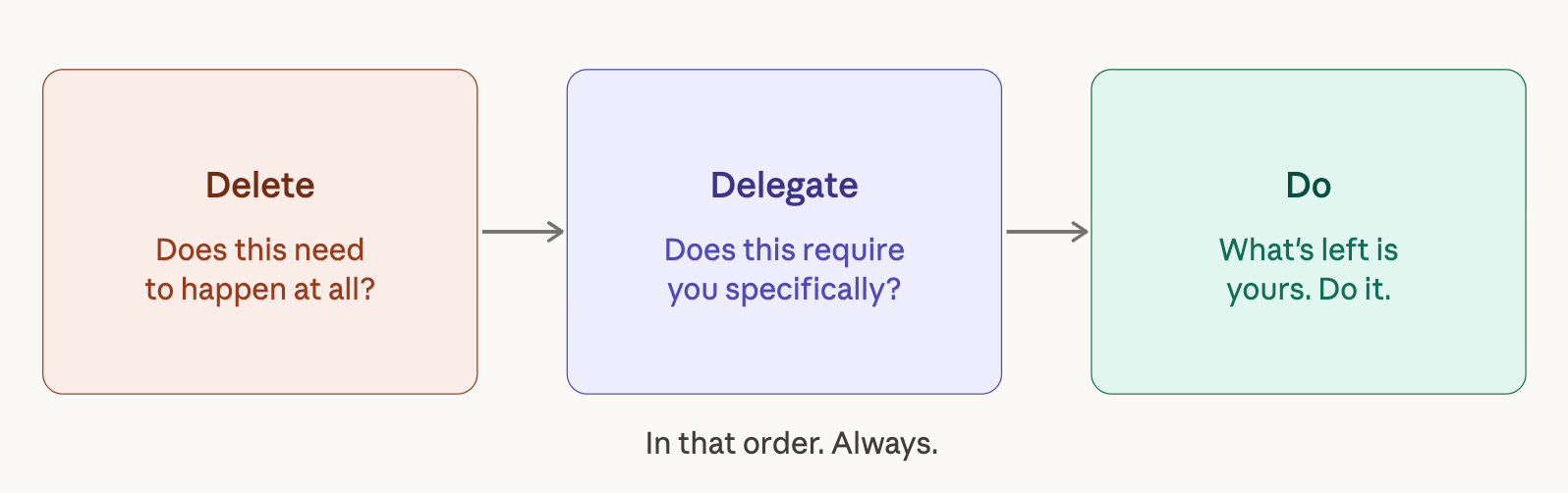
The first move is to delete. Not deprioritize, not defer — delete. Ask the hard question of whether something needs to happen at all. Not everything on your list deserves to exist. Some tasks are busy work dressed up as productivity. Some are vestigial — left over from a version of your job or your life that no longer exists. Some are things you’ve convinced yourself matter because the act of doing them feels meaningful, even when the outcome doesn’t. Delete ruthlessly. Most things survive this step only because no one has bothered to question them.
The second move is to delegate. Once you’ve stripped out everything that doesn’t need to happen, take everything that does need to happen but doesn’t require you specifically, and hand it off. Partner, hire, collaborate — or now, increasingly, use AI. Delegation used to be mostly an organizational challenge. You had to find the person, trust them, build the relationship, manage the handoff. AI has changed the texture of delegation entirely. A growing class of cognitive tasks — research, drafts, synthesis, scheduling, communication — can now be offloaded almost frictionlessly. The bar for what requires a human, what requires you, has shifted significantly.
The third move — and only the third — is to do. What’s left after you’ve deleted what shouldn’t exist and delegated what doesn’t require you. That’s your job. That’s where your energy goes.
This rubric was useful when resource constraints were real and visible. It’s essential now, when they’re not.
The New Constraint
Here’s the thing about infinite productivity: it creates a new constraint that most productivity frameworks aren’t built to handle.
When you can do anything, the limiting factor is no longer capacity — it’s you. Your attention. Your energy. Your judgment about what actually constitutes a good life and a good career, not just a full calendar and a long output log. The question of should has expanded. It used to live mostly in the professional domain: what should I be doing with my time at work, given limited resources? Now it spills into something bigger: what should I be doing with my life energy, given that AI could fill every waking hour with productive-seeming activity?
Measuring ROI in lines of code is a fool’s errand. So is measuring it in deals closed, blog posts published, emails sent, or companies researched. These are outputs. They are not outcomes. And they are certainly not a life.
The real metric has always been harder to quantify — and more important for that reason. What are the things that actually matter to you? Not abstractly, not aspirationally, but concretely, right now, as a person with a finite number of years and a specific set of relationships and interests and obligations that make your life what it is? What does it look like when you spend your energy well?
The shift from a world defined by could to one where could is no longer a useful concept is one of the most significant changes in the structure of productive life in recent memory. It’s not primarily a story about capability — it’s a story about judgment.
About the difference between what’s possible and what’s worth doing.
About the fact that filling your hours has never been the same thing as filling your life.
The infinitely capable person still has to decide what matters. Maybe more urgently than ever. Because the old excuse — I would, but I can’t — no longer applies.
The question has always been should, and now we’ve just run out of reasons to avoid answering it.
Thanks for being a Perishable Knowledge subscriber.
If you are getting value from my blogs, I’d appreciate it if you share this post with someone who will enjoy it. (If you’re reading this email because someone sent it to you, please consider subscribing.)